



[vc_row][vc_column][vc_custom_heading text=”Bachelor of Cybersecurity” font_container=”tag:h2|text_align:center” use_theme_fonts=”yes” el_class=”courses-heading”][vc_tta_tabs style=”modern” active_section=”1″][vc_tta_section title=”Course Information” tab_id=”1636524134494-f345b0d9-fc47b6c4-770f”][vc_toggle title=”Key Facts”]
| Award granted | AAHE course code |
| Bachelor of Cybersecurity | BCYB |
| Study level and type | Credit points |
| Undergraduate coursework | 144 credit points |
| Mode of delivery | Duration |
| Blended: scheduled on-campus, face-to-face classes (three hours per week for each unit) with some online content and activities |
Full time: 36 months (6 trimesters) Part time: 72 months (12 trimesters) |
| CRICOS code | Campus |
| 113867J | Melbourne, Brisbane |
| Australian Qualifications Framework (AQF) | Availability |
| Upon successful completion, the award conferred is recognised in the AQF at Level 7 | Fee-paying domestic and international students |
| Pathways to further study | Course Accreditation |
| The Bachelor of Cybersecurity will meet AQF requirements to allow a pathway to postgraduate studies including Graduate Certificate, Graduate Diploma or Master’s degree. | The Bachelor of Cybersecurity will be seeking accreditation by the Australian Computer Society (ACS). |
[/vc_toggle][vc_toggle title=”Key Dates”]Key Dates[/vc_toggle][vc_toggle title=”Course Overview”]Protecting information and IT infrastructure from complex and evolving cyber-threats is a critical challenge for modern organisations. The responsibility to prevent and respond to cyber-attacks falls to cybersecurity professionals, and global demand for highly trained cybersecurity professionals is at an all-time high and is expected to increase over time.
The Bachelor of Cybersecurity is a three-year full-time course (144 credit points) that provides you with a broad understanding of cybersecurity principles, theory and practice. You will be exposed to real-life case studies on cutting-edge cybersecurity scenarios and trained on state-of-the-art cybersecurity tools and techniques. You will learn to analyse cybersecurity problems and design, implement, evaluate and manage solutions for complex systems and organisations.
The course has been designed with input from leading industry professionals and academics in the field of Cybersecurity, ensuring that you acquire an education that meets industry standards and expectations and is on a par with some of the best national and international benchmarks in the field of Cybersecurity.
Specific knowledge and skills that you will gain throughout the course include cybersecurity fundamentals, cyber law, secure software development, cyber risk management, network security and digital forensics. Other areas covered include project management, basic mathematics and computer networking.
In addition to the core subject areas you can choose electives in specialised units such as critical infrastructure security, embedded systems security and trustworthy systems.[/vc_toggle][vc_toggle title=”Course Learning Outcomes”]On successful completion of this course you will be able to:
[/vc_toggle][vc_toggle title=”AAHE Graduate Attributes”]The AAHE Graduate Attributes below are embedded in the curricula and support the students’ ability to acquire and apply the knowledge and skills that they need to succeed in their personal and professional lives.
| Graduate attribute | An AAHE graduate will: |
| Disciplinary knowledge and skills | Be able to confidently apply their comprehensive, discipline-specific knowledge and skills in professional practice and real-world contexts. |
| Global citizenship and perspective | Possess a deep understanding of the impact that their profession has on society and how it can be used for individual, community and global advancement and well-being. They will develop personal values and practices that are ethically grounded and that embrace diversity, fairness and social and environmental responsibility in local and global contexts. |
| Communication skills | Be aware of and sensitive to specific situations and audiences when presenting and exchanging information, ideas and concepts. They will demonstrate highly developed speaking, listening and writing skills and will be able to influence others with well-articulated and soundly backed analyses and opinions in a respectful, inclusive and constructive manner. |
| Critical thinking and problem solving | A critical thinker whose curiosity and creativity leads them to question ideas and assumptions, draw upon evidence and analyse complex scenarios as they formulate their own conclusions and innovative solutions to current and future challenges. |
| Information and Digital literacy | Be able to identify, locate, analyse and use reliable information effectively and create and convey information in appropriate formats and through effective channels. They will be comfortable utilising a range of digital technologies that are needed to live, learn and work in contemporary society. |
| Self-management and development | Be self-aware and self-directed with the capacity to set priorities, manage time and work independently. They will be confident in their knowledge and skills, but also reflective and continually striving for personal and professional improvement as life-long learners. |
| Teamwork and collaboration | Have the capacity to engage productively with others and contribute as a member of a team to a common goal. This will be demonstrated by a high order of competency in navigating team dynamics, encouraging the exchange of ideas and viewpoints, facilitating conflict resolution, negotiation skills and taking a lead when required. |
[/vc_toggle][vc_toggle title=”Approach to Teaching, Learning and Assessment”]The Bachelor of Cybersecurity will develop your knowledge and skills in the discipline, building towards an authentic work integrated learning (WIL) experience that allows you to apply what you have learnt to real world problems in a professional context and environment. It embeds a collaborative and technology-enabled active learning approach that encourages your participation in the learning process, peer to peer learning and ongoing reflection.
Following a thorough orientation, you will participate in small class groups where you are encouraged to collaborate, exchange ideas, learn from each other and reflect on your learning, both in the classroom and through the collaborative online learning environment.
The typical weekly process begins with you speculating about a problem or scenario that you have been given before the scheduled on-campus, face-to-face class, then actively engage with the class and reflect on the same problem or scenario. Classes themselves are interactive, with regular anonymous polls and multiple-choice questions to encourage active participation. Following the class, you will document your problem-solving process or reflection on the scenario in an online journal. In this way, using the principles of adult learning, you immediately apply your work to problem-solving, and develop into reflective practitioners. The scenarios and problems, along with the class material, are available to you anytime and anywhere through the online learning management system (LMS). You are also encouraged to engage with your peers through multiple opportunities to collaborate and to interact in the classroom and online.
In preparing for major assessments, you will regularly participate in authentic, experiential learning activities. These may be computer laboratory classes, practical exercises such as building a secure network or engaging in an ethical hacking activity, team-based projects or real-world work integrated learning experiences such as working for a client in an industry project or through a work placement.
AAHE’s active learning approach guides the design of units and their content and activities. The assessments build from this approach and are carefully mapped against the unit and course learning outcomes, establishing clear alignment and assuring that the learning outcomes are achieved.
The design of assessments incorporates smaller formative assessment tasks that enable you to receive regular feedback and stay on track, culminating into one or more summative assessments that measure your learning, skills acquisition and the extent to which you are meeting the units’ intended learning outcomes.[/vc_toggle][vc_toggle title=”WIL Requirements”]This course has options for work integrated learning units that involve working on an industry project for a real client or undertaking a placement that involves attending a workplace of an approved host organisation. In such cases, you may be required to undertake a police check, working with children check, immunisation check, or other checks as required.[/vc_toggle][/vc_tta_section][vc_tta_section title=”Course Structure” tab_id=”1636524134548-ff6ac57a-daaeb6c4-770f”][vc_toggle title=”Core Units”]
[/vc_toggle][vc_toggle title=”Elective Units”]
| Unit code | Unit title | Credit points |
| CYB303 | Malware Analysis | 6 |
| CYB304 | Network Forensics | 6 |
| CYB305 | Cybercrime, Cyberconflict and Cyberwarfare | 6 |
| CYB306 | Trustworthy Systems | 6 |
| CYB307 | Critical Infrastructure Security | 6 |
| CYB309 | Industry Project (work integrated learning unit) – subject to availability | 12 |
| CYB310 | Work Placement (work integrated learning unit) – subject to availability | 12 |
[/vc_toggle][vc_toggle title=”Course Progression Rules”]
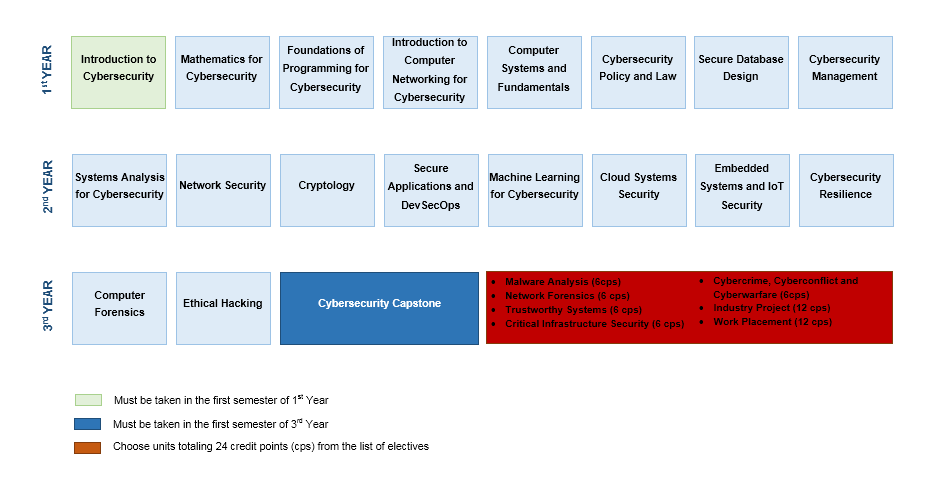
See figure below for full details.
Course progression and unit selections:
 [/vc_toggle][/vc_tta_section][vc_tta_section title=”Careers” tab_id=”1636524226246-b6ce2f6d-4b2fb6c4-770f”][vc_column_text]The Bachelor of Cybersecurity is designed to secure your future professional career in cybersecurity. As a graduate of this Bachelor course, you will have the requisite knowledge and skills to work in operational and management roles in both private and public sector organisations
It is anticipated that graduates of this course will work in a diverse range of domains including government, critical infrastructure, supply chain industry, banks and financial institutions, defence and IT firms. It opens up many opportunities for graduates seeking to enter or advance in the field of Cybersecurity in careers such as:
[/vc_column_text][/vc_tta_section][vc_tta_section title=”Entry Requirements” tab_id=”1636524243934-6cb6095b-1cafb6c4-770f”][vc_column_text]
Students are required to supply their own laptop and bring it with them to all classes.
Due to the technological requirements of this course, it is recommended that students obtain a laptop with the following minimum specifications:
[/vc_column_text][vc_toggle title=”English Language Requirements”]An applicant must provide evidence that they have met the following minimum English language proficiency requirements, or equivalent requirements from other tests accepted by the Department of Home Affairs for student visa purposes:
| Test | Minimum score for Bachelors degree |
| International English Language Testing System (IELTS) | Overall 6.0 No individual band below 6.0 |
| TOEFL internet-based test taken on or before 25 July 2023 or after 4 May 2024 | 75 (Reading no less than 18, Writing no less than 20) |
| C1 Advanced / Cambridge English: Advanced (Certificate in Advanced English) | 169, no band less than 169 |
| Pearson Test of English Academic (PTE Academic) | 50 (no communicative skill less than 50) |
| Kaplan International Tools for English | 426 overall |
Only the most recent score from any language proficiency test will be considered and it must be less than two years old on the date the course commences.
Applicants will also be considered to meet the English language requirements if they have successfully completed at least two (2) years of full-time study in English at AQF Level 5 Diploma or above at an Australian registered vocational or higher education.
A provisional offer may be made to applicants who provide a Confirmation of Enrolment (COE) for an ELICOS program in English for Academic Purposes (EAP) for a duration of at least twelve (12) weeks for every 0.5 below 6.0 overall or subsection IELTS or equivalent result. Evidence of successful completion of the ELICOS program must be provided before the applicant will be permitted to enrol at AAHE.
The English language proficiency requirement does not apply to applicants in the categories set out in the Migration (English Language Tests and Evidence Exemptions for Subclass 500 (Student) Visas) Instrument 2025.[/vc_toggle][vc_toggle title=”Mature Age Applicants”]
[/vc_toggle][vc_toggle title=”Aboriginal and Torres Strait Islander Applicants”]Applications from Aboriginal and Torres Strait Islanders who do not meet the entry requirements will be considered on the basis of a personal statement regarding their education and experience and their results in an aptitude test and an interview.[/vc_toggle][vc_toggle title=”Credit for Prior Learning”]Where appropriate, a student whose prior learning or experience exceeds the requirements for admission to AAHE will be granted credit in accordance with the Credit for Learning Undertaken Elsewhere Policy and Procedure.
[/vc_toggle][/vc_tta_section][vc_tta_section tab_id=”fees” title=”Fees” el_class=”fees-class”][vc_custom_heading text=”Fees” font_container=”tag:h3|text_align:left” use_theme_fonts=”yes” link=”url:https%3A%2F%2Faahe.edu.au%2Ffees%2F|title:Fees||”][/vc_tta_section][vc_tta_section title=”How to Apply” tab_id=”apply”][vc_custom_heading text=”How to Apply” font_container=”tag:h3|text_align:left” use_theme_fonts=”yes” link=”url:https%3A%2F%2Faahe.edu.au%2Fapply%2F|title:Apply||”][/vc_tta_section][/vc_tta_tabs][/vc_column][vc_column][/vc_column][/vc_row]